Operations
Jet-A at $7.99: What the 2026 Fuel Spike Changes About How FBOs Talk About Price
October 20, 2026
The national average retail price of Jet-A reached $7.99 a gallon in September 2026, the highest monthly average GlobalAir.com has reported this year and nearly 28 percent above a year earlier. For an FBO general manager, the number itself is the smaller problem. The larger one is that pilots now check price before every leg, prices change weekly, and the price a pilot finds online, the price on your website and the price your CSR quotes at the counter have to be the same number every time.
That is a communication job, not a pricing job, and it is one most FBOs have never had to do at this pace.
Where the number stands
GlobalAir.com's monthly Fuel Spotlight is built from prices "reported directly by the FBO" at more than 3,200 FBOs, each required to re-verify at least every 30 days. Its September 2026 figures, published October 2 (the Jet-A change is computed from the $7.78 August average in the same series; the other two are as GlobalAir states them):
| Fuel | September national average | Change from August |
|---|---|---|
| Jet-A | $7.99 / gal | +21¢ |
| 100LL | $7.59 / gal | +8¢ |
| Blended SAF | $10.23 / gal | +23¢ |
August was already the fifth consecutive month of Jet-A above $7.00; the previous 2026 high was $7.93 in May. Comparing regional spot prices on August 31 and September 30, the Jet-A increases were steepest in the New England, Eastern, Southern, Southwest and Great Lakes regions (42–59 cents) and smallest in the Northwest Mountain, Central, Alaska and Western-Pacific regions (16–27 cents), so a Florida or Northeast FBO saw a bigger jump than one in the Mountain West.
Two cautions on the numbers. First, panels differ. For the same month, Aviation Week's survey of "more than 200 FBOs" by the Aviation Research Group put the September average at $8.49, up 18 cents from August and $1.96 year over year, with the Western Pacific region at $9.16; iFlightPlanner's panel of 3,370 FBOs and fuel providers had full-service Jet-A at $8.36, up 39 cents. Three surveys, three Septembers: $7.99, $8.36, $8.49. Quote one and name it. Second, GlobalAir attributes the run-up to supply disruption in the Middle East, with refined product moving through the Strait of Hormuz at "less than one-fifth of prewar pace" and a $22 gap between Brent spot and futures on September 15 signaling tight physical supply. That is their reading of the cause, and the article offers no timeline for relief.
Why price communication is now a weekly task
Three facts about how fuel prices reach a pilot explain the workload.
Prices move weekly. Sheltair's own explainer for customers says plainly that "fuel prices fluctuate weekly," and describes its quotes as itemized so the customer can see the government taxes, airport-specific fees and environmental surcharges added to the base price per gallon (Sheltair, Dec 2, 2025, updated Aug 28, 2026).
Third-party listings are only as good as your last update. AirNav's guaranteed prices are "reported to AirNav by the participating FBO," "only employees approved by the FBO can update" them, and they are "only guaranteed for the precise moment they are displayed." The guarantee covers retail transient into-plane fuel and "may not apply to customers with special arrangements, contract pricing, locally based aircraft" (AirNav fuel price guarantee). If a pilot pays more than the posted guaranteed price, AirNav contacts the FBO for a refund.
Pilots still phone. The Government Accountability Office's 2019 review of FBO pricing found fuel prices "readily available on third party websites such as AirNav and Sky Vector," but only "about a third of the websites for FBOs we visited" showed them, and "16 of the 18 pilots we interviewed told us they call the FBO in advance" to pin down total cost (GAO-20-16, pp. 7–9). The report is nearly seven years old; the behavior it describes has not gone away, because the thing pilots are calling about, the fees, still is not posted.
So an FBO that changes its Jet-A price on Tuesday has at least three places to change it: the third-party listings, its own website, and whatever the customer sees at the counter and in the lounge. When those drift apart, the pilot discovers it on the invoice.
Fees are where trust actually breaks
The fuel number is the easy part. In February 2025 AOPA documented a TBM pilot's trip to Aspen that "incurred a $598 charge because of Martin Luther King Jr. Day"; the FBO "also charged a $25 habitat fee and a $150 security fee but waived the $365 ramp fee with his fuel purchase." Another member reported a $419 turboprop ramp fee for his Piper M600 at an FBO that charged piston aircraft $45, and AOPA said members keep reporting fees raised "for federal holidays and long weekends or during trade shows and conventions" — in one member's words, "they come up with a 'special event' for anything they possibly can" (AOPA, Feb 13, 2025). AOPA's stated goal is fees that are "fair, justified, and established in a transparent manner."
The regulatory frame matters here, and it is narrower than many GMs assume. The FAA has said directly that "the Federal government does not regulate the pricing of FBOs." What it does require, through Grant Assurance 22 at federally obligated airports, is that the airport sponsor ensure FBO pricing is "reasonable and applied in a non-unjustly discriminatory manner," and the FAA's guidance adds that "fees, rates, and charges should be disclosed and made publicly available" (FAA Q&A on FBO consolidation and pricing, Dec 7, 2017). Posting your fees is good customer practice; it is also the disclosure the FAA's guidance tells airport sponsors to expect.
The industry's voluntary answer, the "Know Before You Go" transparency guidelines, were spearheaded by AOPA and five other industry associations in 2018. By the end of 2019 AOPA counted only 300 FBOs that had posted fees for piston and turbine aircraft, out of roughly 3,070 FBOs at 3,016 airports in the contiguous United States, and said fees should be "clear, well communicated, and easily accessible online" (AOPA, Dec 31, 2019). We did not find a current participation count; treat the 300 as a 2019 figure.
The chains have made transparency a product
Two of the largest networks reorganized their customer offer around price clarity this year.
In February, Signature Aviation launched Signature Vision, a guest portal whose headline features include "pricing visibility by location," described as "access to company-specific pricing by location across services and fuel types, providing the clarity and confidence to plan before arrival," alongside real-time service-status notifications, across a network of "over 200 locations" in 27 countries (Signature release, Feb 11, 2026).
In August, Atlantic Aviation rolled its Ascend program out network-wide: free to join, no contract, "discounted, non-negotiated Jet A pricing throughout the Atlantic network," and quarterly rebates of up to 15 percent on eligible service fees for operators who direct at least 90 percent of qualifying trips to Atlantic at competitive airports for three or more consecutive quarters (Atlantic's wording is "at least 90%"). Atlantic says it was "built around fuel savings and operating-cost reduction rather than points accumulation" (GlobalAir, Aug 21, 2026).
An independent FBO is not going to build a portal. It does not need to. The principle both programs sell is simple: the customer knows the price before the aircraft lands, and the price does not change on arrival. That is achievable at one location with discipline and the right tools.
Do not discount your way out of it
The reflex when a competitor across the field cuts price is to follow. The arithmetic argues against it. In a worked example from the Aviation Business Strategies Group, an FBO selling 10,000 gallons a week at $4.14 with a $2.68 cost earns $14,600 in gross margin; raising the price 41 cents and selling 9,000 gallons instead raises weekly gross margin to $16,830. The same authors calculate that a 7 percent discount means "you have to sell another 2,372 gallons just to make the same money before the discount. That's almost 24 percent more gallons." Their advice: "compete on customer service, not on price" (ABSG, Mar 27, 2017). The prices are from 2017; the ratios are not.
Volume, for most FBOs, is not the problem this year. ABSG's 2026 fuel-sales survey found "more than 50% of FBOs responding" reported higher 2025 fuel sales, with "a record 23%" up more than 8 percent, "the highest reported percent gain for our top category in the history of the survey dating back more than 11 years." The same survey found 28 percent of respondents at airports that charge a concession fee, and 20 percent of all respondents passing it through to customers (ABSG, Mar 18, 2026), which is one more line item a pilot deserves to see before the invoice.
GlobalAir's own advice during the spring run-up was to move in steps rather than hold flat and then jump: "a modest increase can keep you lower than the competition, build margin on remaining inventory and begin setting customer expectations before your own resupply hits" (GlobalAir, May 21, 2026, updated Oct 1). Setting expectations is the operative phrase. Every step needs to be visible.
A price-communication checklist for the FBO
None of this requires software. It requires deciding, once, how your FBO talks about price.
- One owner, one sitting. Name the person who changes the price and have them change every surface in the same sitting: GlobalAir, AirNav and any other listing you participate in, your website, and the counter and lounge. A price that is right in two of four places is wrong.
- Post the whole stack, not the base. Base price per gallon, taxes, airport fees and any surcharge, itemized the way Sheltair describes it. A pilot comparing your $7.89 to a neighbor's $7.79 cannot tell which one includes the flowage fee unless you show it.
- Publish fees with the same care as fuel. Ramp, handling, overnight, after-hours, and the fuel-purchase thresholds that waive them. This is the information GAO found pilots phoning for, and the disclosure the FAA's guidance says airport sponsors should expect.
- Announce event and holiday pricing before arrival. If a convention week or a holiday carries a surcharge, say so on every surface the week before, in the same words the invoice will use. The Aspen holiday charge above became a national story because it was a surprise, not because of its size.
- Give CSRs the one-sentence answer for "why three prices?" Posted retail, contract or card pricing, and based-customer pricing are different products for different customers. A CSR who can explain that in a sentence turns a complaint into a conversation.
Where a synced lobby screen fits
Step one on that list is where most FBOs slip, because the counter and the lounge are the surfaces nobody owns. A printed price sheet taped to the counter is updated when someone remembers; a TV loop built in a slide deck is updated when someone has an hour.
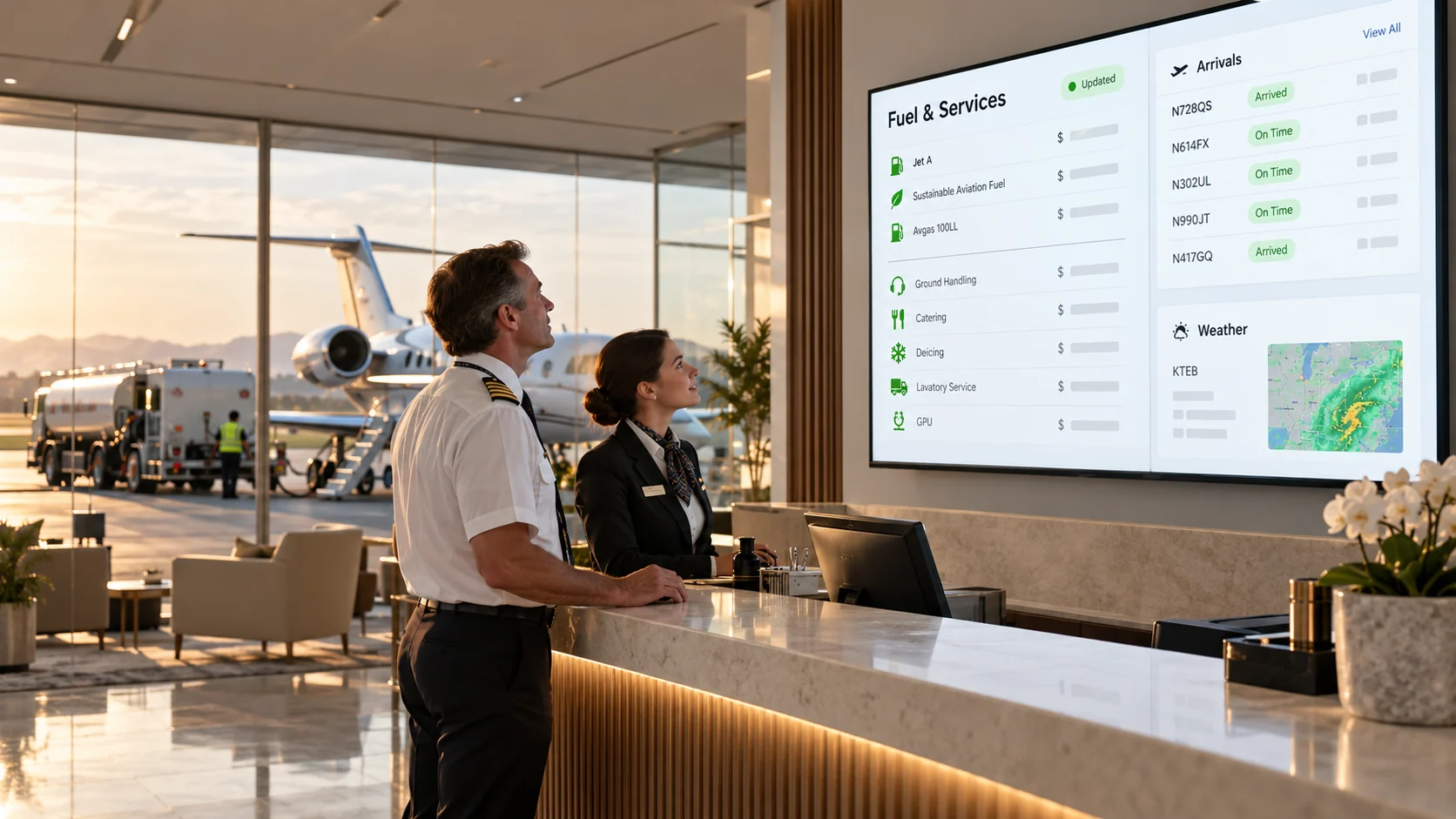
This is the problem Sky Sync's Customer Experience Display is built around. Fuel and services pricing is one panel of an FBO-branded lounge screen, alongside tail-number arrivals and departures, weather and radar, and QR codes for concierge requests. Your team enters a price change once, from the office or a manager's iPad, and the update reaches every screen in the terminal, and in every location if you run more than one, within minutes. There is nothing to print, no USB drive, no on-site visit. The same sitting in which someone updates AirNav is the sitting in which the lobby changes, and the pilot who checked the price on the ramp-side listing that morning sees the same number when they walk in.
The screen does not set your price or pull it from anyone else's listing; it shows the price you publish, with the time it was last updated, so that the number in the lounge is never older than the number online. For FBOs that want the ad-supported version first, the Promotional Screen runs at no monthly cost and carries the same operational information between advertisements.
The takeaway
Retail Jet-A averaged $7.99 in September on GlobalAir's panel, and no published forecast puts a date on relief. The response that protects margin and reputation at the same time is not a lower price; it is a price that is itemized, posted everywhere a pilot looks, and identical in all of those places, changed by one person in one sitting. The largest chains have turned that principle into portals and loyalty programs. An independent FBO can deliver the same certainty at the counter and on the wall, and the wall is the surface that has been easiest to neglect.
Sources: GlobalAir Fuel Spotlight, Oct 2, 2026 · GlobalAir, Sep 3, 2026 · GlobalAir, Jun 1, 2026 · Aviation Week, Sep 15, 2026 · General Aviation News / iFlightPlanner, Oct 6, 2026 · Sheltair Aviation · AirNav Fuel Price Guarantee · GAO-20-16, Nov 26, 2019 · AOPA, Feb 13, 2025 · FAA Q&A, Dec 7, 2017 · AOPA, Dec 31, 2019 · Signature Aviation, Feb 11, 2026 · GlobalAir, Aug 21, 2026 · ABSG, Mar 27, 2017 · ABSG, Mar 18, 2026 · GlobalAir, May 21, 2026